


In Step with Knute Berger: Berger Mining the Northwest’s Hidden History

By Richard Hao, Youth Director At Large
Edited by Laura Lee Bennett, Executive Vice President Photos by Cascade PBS and Redmond Historical Society
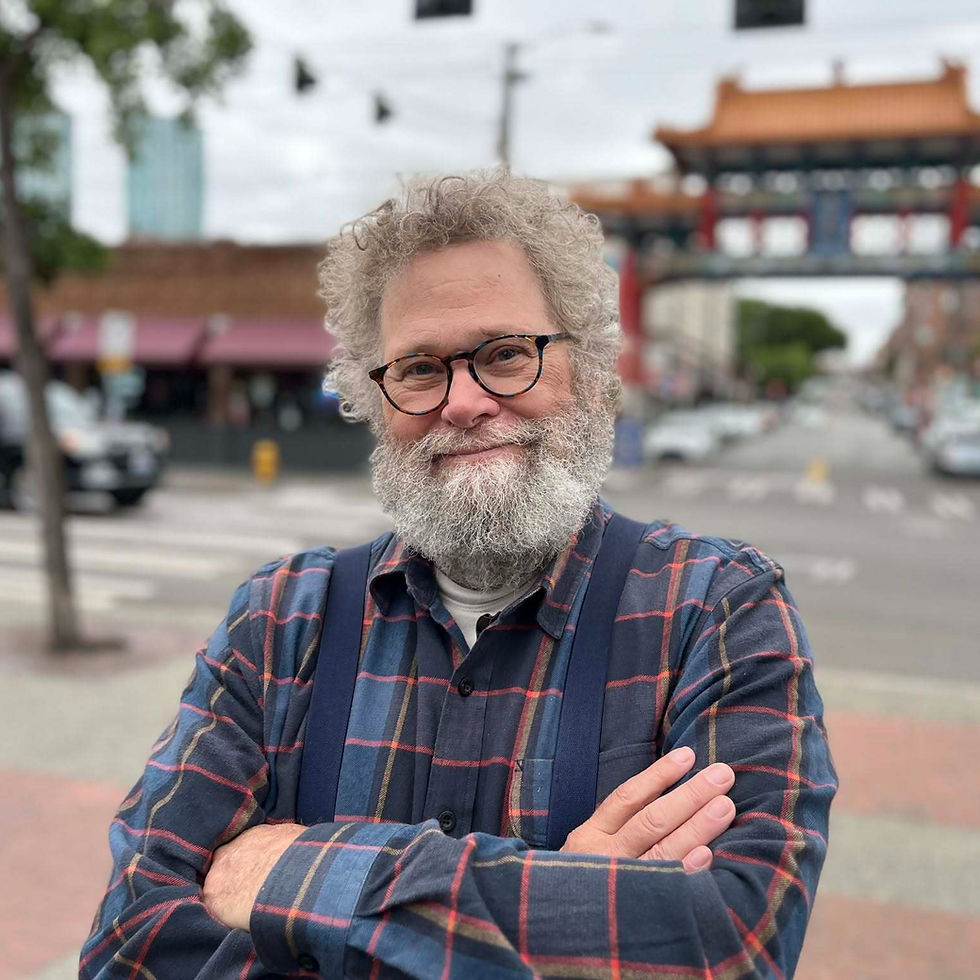
On October 10, 2026, the Redmond Historical Society welcomed back award-winning journalist Knute Berger, creator and host of the Cascade PBS series, Mossback’s Northwest. More than 80 people turned out for a lively preview of the show’s 12th season.
Waving his paper notes and claiming "There's no AI here," and declaring he had “two feet in the analog world,” Knute explored the region’s quirky, surprising, and often overlooked history—from Salish Sea pirates and Seattle earthquakes to Bruce Lee and a mysterious artifact from a legendary shipwreck. He also shared how he mines the Pacific Northwest’s “historical and cultural nuggets” to uncover stories of grit and resilience.
We caught up with Knute for a bit of Q&A.

RHS: You’ve spent a lot of your career exploring the history of the Pacific Northwest. Was there a specific experience or discovery early on that sparked your interest in local history, maybe even before you got into broadcasting or hosting?
Knute Berger: I grew up in a neighborhood in Mount Baker where my grandparents and my father had lived. We lived just a couple blocks from where my father grew up. He would tell me stories about the neighborhood and what it used to be like, and he had lots of great stories from his childhood that intrigued me. I would sometimes go out and try to find the places he had talked about, many of which no longer existed.
I remember him telling me that Lake Washington had been higher. It was lowered when they built the ship canal—they began lowering the lake when they built the Montlake Cut. I think 1916 would have been somewhere in there. He told stories about the place where they had the hydroplane races, the Stan Sayres pits. He told me when he was a kid that it was an island, and you could take a canoe all the way to Columbia City, which is a neighborhood down there. Of course, now it’s land. In all my childhood, that was all landfill and there was no island there anymore. So I was fascinated with the history of the neighborhood as it had been lived in by my dad.
I also wanted to know where we were in American history. When I was nine or ten years old, it was the 100th anniversary of the Civil War. So I was curious. My great-great-grandfather knew Abraham Lincoln. I knew that.
RHS: Cool!
Knute Berger: Yeah. Actually, not Lincoln, but previous to Lincoln—I can’t remember if it was Zachary Taylor or somebody—who had appointed my great-great-grandfather to be the Surveyor General of the Oregon Territory. He turned it down because it was a thankless job way out in the wilderness. So I knew about these things; I’d been told by the family. But I was curious at a very early age: where do we stand geographically, and where do we stand historically in American history?
“I was curious at a very early age: where do we stand geographically, and where do we stand historically in American history?"
– Knute Berger
That was a question I thought about, read about, and tried to learn about, but it wasn’t anything taught in schools. Basically, history here started when the Oregon Trail came, and had nothing to do with Indigenous peoples, nothing to do with anything that might have happened before or after the Oregon Trail. It was all about pioneer settlement.
I became interested in local history very early. It seemed dull to me until I actually learned something. At first, I just thought the Dennys and the Borens sounded like boring people. I wanted to know more about—well, were there any famous battles here?
RHS: That’s exactly me too. When I first got into the Redmond Historical Society, I was always looking for those Wild West tales, or some Lexington and Concord of Washington or the Pacific Northwest. But so much of local history is super cool—even just seeing everything change over time.
Knute Berger: Yep. In fact, if you’re interested in violent history, wars and that kind of thing, we have loads of it. It’s just not highlighted, and a lot of it doesn’t put the settlers in a very good light. Also, the Northwest played a central role in colonial empire expansion in the 18th and 19th centuries—the Pig War, for example—where you had Russia, France, Spain, England, and America all fighting for this region, because they wanted its resources and its geographic position. That was the kind of thing we weren’t taught in school, and it’s actually really interesting.
RHS: It is. So when you had this interest, did you imagine yourself becoming a journalist and historian, or did those thoughts come gradually as your exploration went on?
Knute Berger: They came later. I was always interested in history, and I was a late bloomer as a reader. I looked at lots of magazines and history books, mostly for the pictures. I read some of them. I didn’t really get kicked off on reading until I was in fifth or sixth grade, and our school library had a series of juvenile biographies for young readers of people from history. It might be Sacagawea, it might be Jim Thorpe, the athlete, or Thomas Edison—those are a few of the ones I remember reading. That ignited my interest in learning about people of the past, especially famous people of the past.
While that was going on, my interest in writing was [poetry]—I wanted to be a poet. My mother had a medical background, but on the side, she wrote poetry. She would get up at four in the morning and write poems and send them off to poetry journals. She took classes at the UW in poetry. She was actually quite good. She took me to poetry readings and things like that. And I was thinking, well, if I’m going to be a writer, I want to be a poet. I actually took a poetry class at Lakeside that was influential to me.
When I told my mother that I was thinking of becoming a poet, she said, “Well, you’ll never make any money at that. If you want to be a writer and you want to make a living, you should be a journalist.”
This was right around the same time. I actually helped start a very short-lived mimeograph newspaper at Overlake [School] called the Periodical Chronicle. It only lasted a couple of issues, but when I went to Lakeside, I started writing for the high school paper, the Tatler. It was run by a bunch of seniors who were very irreverent, and I fell in love with impertinent journalism. I really enjoyed the whole process of putting out a school newspaper. When I went to college, I helped start the newspaper at Evergreen State College and was editor there. I decided, okay, I want to be in the newspaper and magazine business. And I’ve been in it ever since.
RHS: Where did the television aspect come in?
Knute Berger: In the ‘90s, KCTS 9—the public TV station where I work now, Cascade Public Media, back then it was just KCTS 9—had a weekly weekend review show where they invited journalists to do a roundtable every Friday and talk about the news of the week. At that time, I was editing a newspaper on the Eastside based in Kirkland, and they asked me once or twice a month to be on this panel. So I started appearing on television, where I would be interviewed along with these other people and asked to weigh in on different topics. That also led to doing something similar on KUOW for years, on their Friday Week In Review.
After a couple of years of being on the public television show, which had a real following, I [decided], I don’t think TV’s my thing. I’m a writer. Printed words are what motivated me.
After the news site I worked for, Crosscut, merged with Channel 9 to become Cascade Public Media, we’d been working together for about a year.
I had no yearning for TV. But I did know a little something from my radio experience about how to write for speaking, and I adapted that to the TV stuff. And of course, we started small, so I was among friendly people. It just grew into something, but I didn’t expect it to.
RHS: Much of your work focuses on stories that are overlooked, forgotten, or rarely told. How do you decide which overlooked historical stories deserve to be brought back to light—and which might not?
Knute Berger: I’m obsessed with my sense of what’s interesting that might be neglected. I think of each season as being like a curio cabinet. My family had a curio cabinet when I was growing up. It was an old map case with a glass top, and it was full of things like an exotic egg from some bird overseas, or old nails from a homestead. It had a lot of interesting artifacts in it. Many of them were related to family and friends, but some of them were things that my parents had picked up over the years. I loved the idea that you could look in this glass case and there would be all these stories embedded in these intriguing artifacts that didn’t necessarily tie together. They’re like separate chapters of a big book.
“I think of each season as a curio cabinet, filled with intriguing artifacts and the stories embedded in them. They don’t necessarily tie together—they’re like separate chapters of a big book."
– Knute Berger
When I put the season together, I look for certain kinds of stories that I could add something new to, or [that have] a strong visual resource that people aren’t necessarily aware of. I want people to understand that our history is way more diverse. And by diverse, I mean we’ve always had a lot of diversity in the population here, but it’s not reflected in most of our history. So I look for a diverse set of things.
“When I put the season together, I look for certain kinds of stories that I could add something new to, or [that have] a strong visual resource that people aren’t necessarily aware of. I want people to understand that our history is way more diverse. And by diverse, I mean we’ve always had a lot of diversity in the population here, but it’s not reflected in most of our history. So I look for a diverse set of things."
– Knute Berger
Then I’ve set parameters. I can go back 15 million years if I want to tell a certain story. I look for [information] that is at least 50 or 60 years old, but sometimes it’s more recent. For example, we did a story on “Why did they blow up the Kingdome?” Things like that. I try to have a mix of time periods in each season.
I’ve read tons of Northwest history. I’ve looked through archives, I’ve researched all kinds of subjects, I’ve been through lots of newspapers. If something strikes me as like, “Oh wow, who knew?” I figure other people will be struck by it.
RHS: If someone was conducting an oral history interview with a resident of the Pacific Northwest 50 years from now about our modern society, what would you want that person to understand about our region?
Knute Berger: It’s funny, I’ve been thinking about this in a slightly different context. It would be to look at us complexly—not to simplify who we are or who we were. I think there’s [an] inherent contradiction in the way we do things here.
One is that we have been in a huge driver’s seat in terms of industry, growth, business, and resource exploitation—starting with cutting down the forests, fishing out the salmon, building dams, Grand Coulee and all the dams on the Columbia, industrializing. It goes to Microsoft, Amazon, all that kind of stuff.
Alongside that, many of the people who moved here—and because our colonization and settlement happened so late in the American story—people came here and saw this area as kind of a blank slate. On the one hand, you could exploit it for money. And on the other hand, people had this vision of, well, we can do things better here than have been done. We can learn from the lessons of the class system back East, or in New York. We can build a “city on the hill” community here. And I say community as if it’s a single thing.
“Because our colonization and settlement happened so late in the American story—people came here and saw this area as kind of a blank slate...
– Knute Berger
We have this weird [tendency to be] super exploitative. And then this other tendency to be very utopian. Washington and Oregon had all these utopian communities in the 19th and early 20th centuries: socialist communities, cooperatives, and religious communities. I think that infuses our values along with the other thing. We’re still trying to reconcile idealism and greed. That’s the simple version. And I think that’s a problem throughout history, throughout modern history—throughout the history, perhaps, of most civilizations.
I’d like people to see us in that context. There’s a lot to admire about us, but there’s also a lot to be totally disgusted by. Often [historians] tend to want to look at the big picture in very simple terms. And I would ask people to pay attention to context. That’s always been a big thing in my writing: if you’re trying to explain things, you have to explain the context of the decisions that were made. Does that make sense?


Comments